
The Electrical Engineering department at KFUPM came into existence with the establishment of the University of Petroleum & Minerals in 1967. It is one of the largest departments in the University with an average number of students being approximately 900, 16% of whom are in the graduate program. The department provides 2 four-year undergraduate programs, Bachelor of Science in Electrical Engineering and Bachelor of Science in Electrical Engineering and Physics. The graduate program offers Master of Science and Master of Engineering in Electrical Engineering, Master of Science in Telecommunication Engineering, Master of Sustainable and Renewable Energy, Master of Wireless Communication Networks, and Ph.D. in Electrical Engineering.
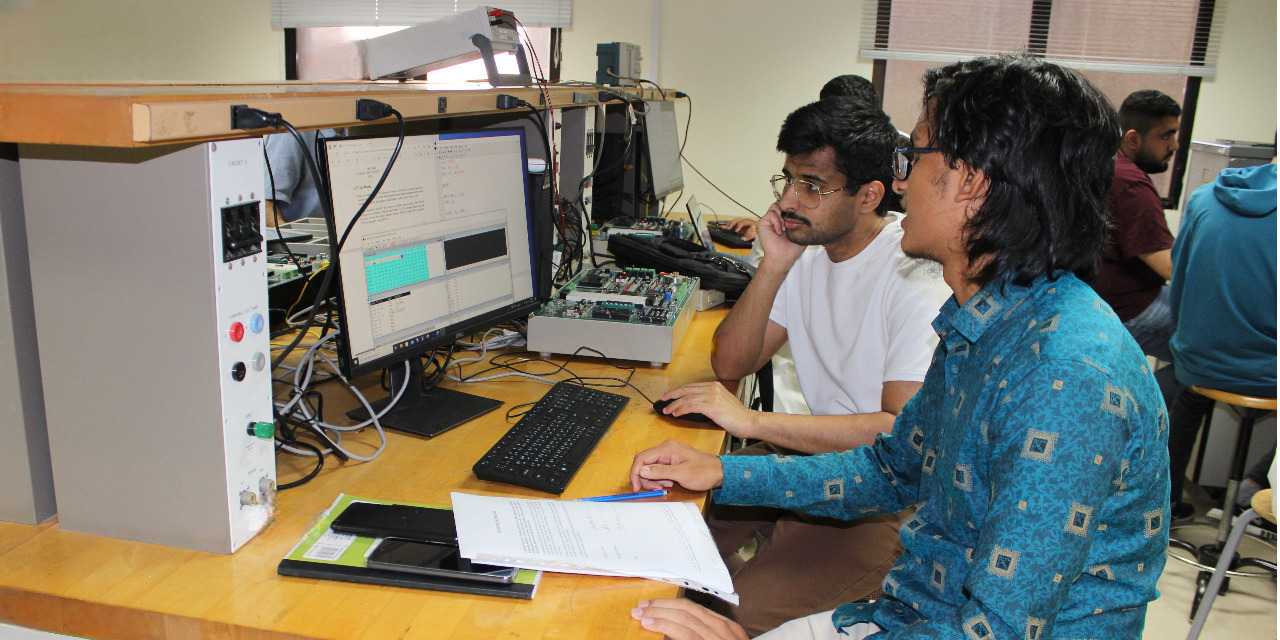
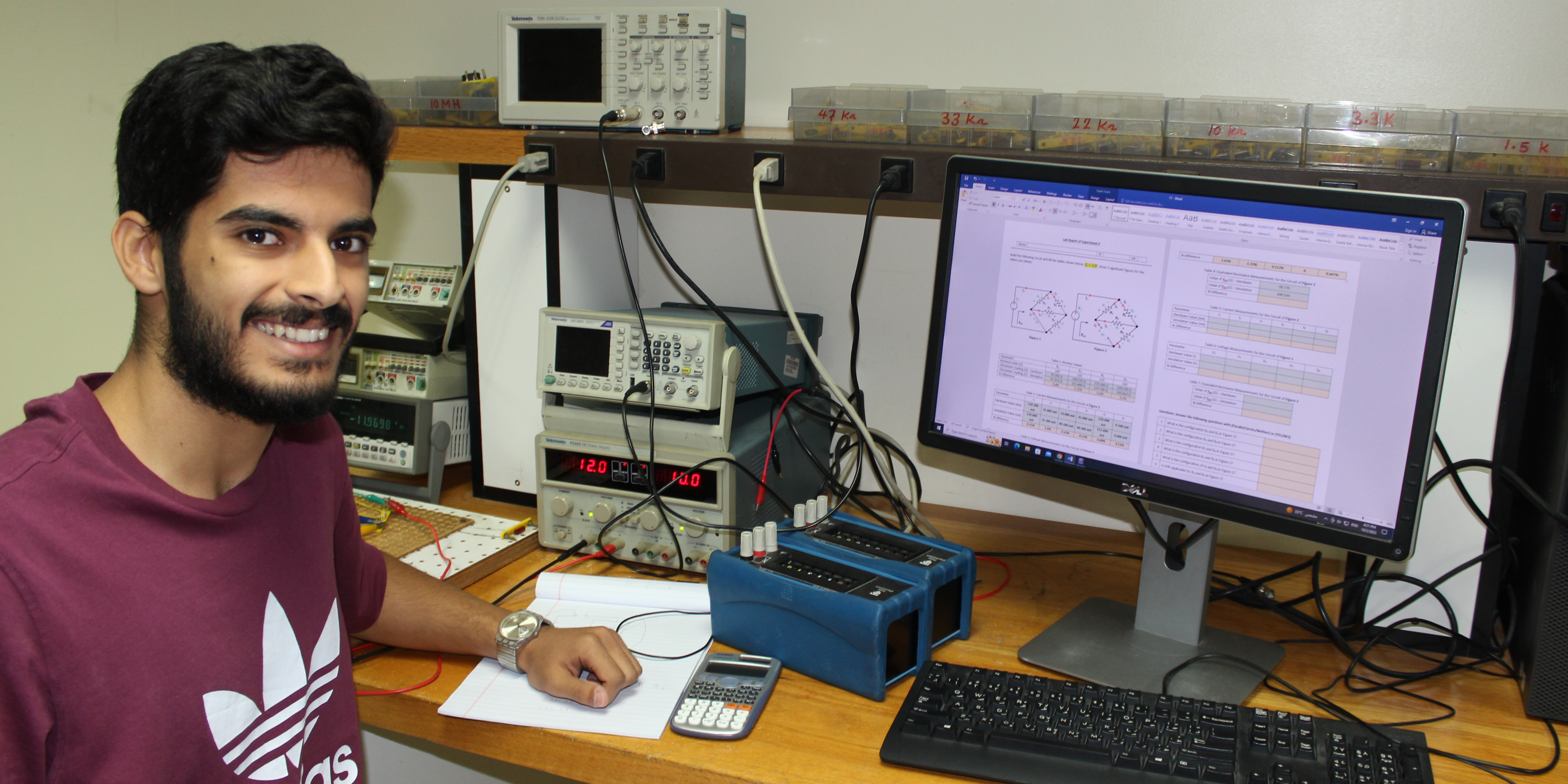
The department has about 61 full-time faculty members in 6 specialized areas of research. The Groups in the department are: Energy Systems, Communications, Electronics, Control Systems, Electromagnetics, and Digital Signal Processing. Additionally, a pool of experienced engineers and technicians maintain more than 30 laboratories in the department.
To be globally known for skillful graduates and quality research with focus on national needs.
On October 1, 2025, the Electrical Engineering Department hosted a seminar titled “Chaotic-Cavity Lasers for Emerging Applications,” presented by Dr. Omer Alkhazragi.
The session highlighted how semiconductor lasers—vital from frontier science (e.g., LIGO) to everyday devices (e.g., smartphones)—can be limited by their very strength: high coherence. Dr. Alkhazragi explained how coherence leads to speckle, degrading imaging, lighting, and display quality, and how long coherence length constrains resolution in interference-based sensing.
He then introduced chaotic-cavity designs that deliberately tailor spatial and temporal coherence to suppress speckle, improve image and projection fidelity, and enable higher-resolution sensing. The talk also covered practical design considerations and additional advantages of chaotic cavities, pointing to promising pathways for next-generation imaging, lighting, display, and sensor applications.
The following are the highlights of the event:


Semiconductor lasers have been widely used in a wide range of applications, ranging from scientific research (e.g., in LIGO) to everyday consumer electronics (e.g., in smartphones). Highly coherent light emitted from lasers, although beneficial in these specific applications, suffers from the formation of speckles, resulting in poor imaging, lighting, and projection/display quality. Moreover, the long coherence length limits the resolution in interference-based sensing. In this talk, we discuss chaotic-cavity designs that can alter the performance of semiconductor lasers to enable their use in new emerging applications. We also highlight additional advantages introduced by employing chaotic cavities.
.png?sfvrsn=4f0fdc3b_1)
Building 59-2018
01 Oct, 2025
02:00 PM - 02:50 PM
The Electrical Engineering Department (EE) at KFUPM provides a world-class education and innovative learning experiences for both undergraduate and graduate students.
Click on the following button to access online admissions application portal :